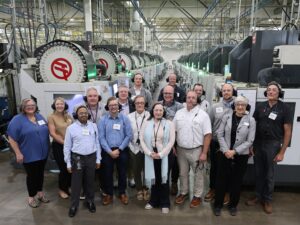
BROOKLYN PARK, Minn. (June 12, 2026) — A bipartisan group of Minnesota state legislators visited Protolabs’ Brooklyn Park facility on Wednesday, June 10. The group experienced a firsthand look at how a Minnesota-born digital manufacturer turns a digital design into a finished, custom part in as fast as a day. Those attending at Protolabs were Reps. Harry Niska, Kristin Bahner, Dave Baker, Jeff Witte, Wayne Johnson, Danny Nadeau, John Huot, and Jon Koznick. The visit, part of the Minnesota Business Partnership’s Legislative Visits program, showed lawmakers how AI-enabled manufacturing is shortening product-development timelines for customers in aerospace, defense and medical device, and how state policy shapes advanced manufacturing’s future in Minnesota.
The MBP Legislative Visits program brings state legislators and officials inside Minnesota Business Partnership member companies to connect policymakers with real-world operations and the decisions behind them. As Minnesota Business Partnership CEO Kurt Zellers reminded the group at the outset, the visits are built to be interactive — a working conversation, not a ‘look & see’ walkthrough.
Inside the Brooklyn Park facility, one of the company’s Minnesota CNC machining operations, lawmakers saw how Protolabs turns a customer’s digital design into a finished part. An engineer anywhere in the country can upload a 3D design to the company’s website, where AI-driven software analyzes it within minutes, flags potential manufacturing problems before any material is cut and returns a price along with a choice of delivery speeds. Orders are then sequenced automatically across a floor that runs around the clock on four shifts. The output is the manufacturing of 60,000 parts monthly, with more than 85% shipped in under three days.
The roughly 250-person operation runs on a mix of engineers, machine operators, material handlers, maintenance and tooling technicians, and quality inspectors. Company leaders proudly highlighted an employee-retention rate above 90% and a track record of promoting workers from the production floor into engineering roles, evidence, they said, that advanced manufacturing creates good-paying careers, not just jobs.
Suresh Krishna, Protolabs CEO, framed the company’s work as part of a larger opportunity to rebuild American manufacturing. Rather than trying to recreate the low-cost, high-volume model that moved overseas decades ago, he argued, the United States can compete by winning on innovation and speed, designing, making and shipping critical parts in days instead of weeks or months, and keeping that work close to the customers who need it. He pointed to national defense and supply-chain resilience as reasons the capability matters.
Protolabs traces its roots to a 1999 idea: that custom manufacturing could be digitized the way e-commerce reshaped retail. Today the company is based in Minnesota, where it runs three factories and its headquarters, bases roughly half its workforce and does its software development. Krishna told the group Protolabs invests 8% of revenue in research & development technologies—Far more than a typical manufacturer. The work supports highly skilled engineering jobs in the state. The company has made more than 700 million parts over the last 25 years and serves 95% of the Fortune 100.
The company’s services span injection molding, CNC machining and 3D printing, including metal 3D printing used for products ranging from titanium medical implants to aerospace components.
True to the program’s emphasis on dialogue, the session was heavily interactive. Legislators pressed on the skilled-trades workforce, how to prepare students for good-paying manufacturing jobs straight out of high school or a trade program, along with cybersecurity and the protection of customers’ intellectual property, and the range of materials and parts the company can produce. The bipartisan group and company leaders also talked frankly about the workforce and cost pressures that shape where a multistate manufacturer chooses to invest.
“Protolabs is one of those great Minnesota stories — a company that decided 25 years ago to accelerate manufacturing processes with software, and is still doing it today,” said Suresh Krishna, president and CEO of Protolabs. “We are proud to be doing that work here in Minnesota as America brings manufacturing back stateside through the ability to advance innovation with speed.”
“Our MBP Legislative Visits work because they’re a conversation,” said Kurt Zellers, CEO of the Minnesota Business Partnership. “Protolabs shared with legislators what a Minnesota company can do when it leads on innovation, and, just as important, what kind of partnership it will take to keep that growth and those jobs here in our state.”
The visit is one of several the Minnesota Business Partnership is hosting with member companies across the state.